

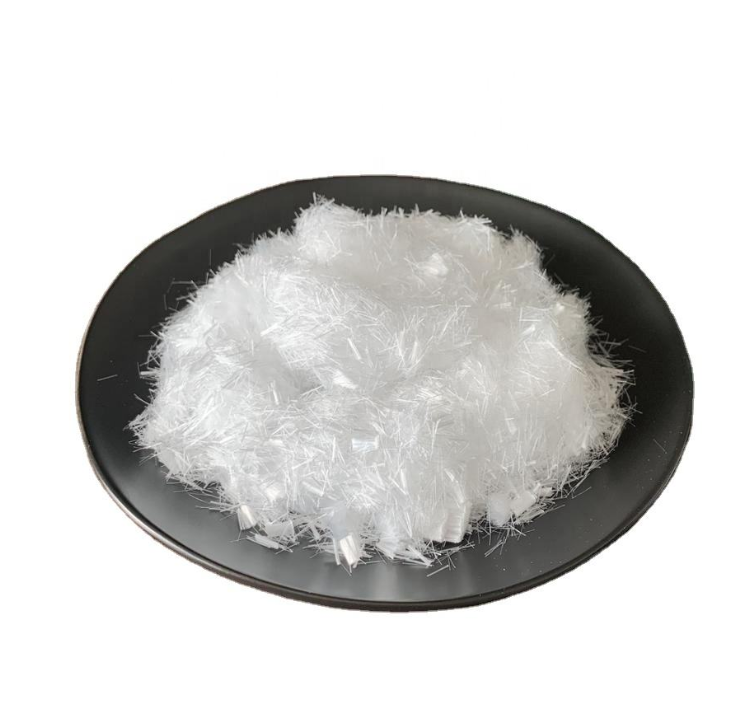
PP Fiber
What Is Polypropylene Fiber (PP Fiber)? Uses, Crack-Control Mechanism, Dosage and Grade Selection
1. What Is Polypropylene Fiber (PP Fiber)?
Polypropylene fiber (PP fiber) is a synthetic fiber made from polypropylene resin by melt spinning, drawing and cutting. It appears as a white or pale-yellow short fiber.
It is a non-polar fiber: its molecules carry no electrical charge and do not absorb water. That matters in concrete, because cement paste becomes strongly alkaline once it hydrates (pH above 12). Steel fibers corrode in that environment; polypropylene is unaffected by acid or alkali, does not conduct electricity and does not rust, so it stays stable inside concrete over the long term.
Its first job in concrete is crack control. After placing and before it fully hardens, concrete shrinks as water evaporates and the paste contracts — and at that stage it has almost no strength, so it cracks. These are plastic shrinkage cracks, the most common early defect on concrete surfaces. PP fiber is distributed through the mix in tens of millions of individual fibers per cubic metre, holding the still-soft paste together and spreading the shrinkage stress across countless fibers. Even where a micro-crack starts, fibers bridge across it and stop it widening into a through-crack.
2. Why It Works: Core Properties
These behaviours are what set PP fiber apart from other fibers — and why it is so widely used.
Crack control
This is its main function. The fibers form a three-dimensional random network inside the concrete, restraining shrinkage during the plastic stage and breaking what would have been one large crack into countless small, disconnected ones — or preventing cracking altogether. In thin sections such as renders and decorative mortar, the effect is immediately visible.
Impact and fatigue resistance
The fibers bridge across cracks: under impact or repeated loading, the energy absorbed in pulling or breaking them out prevents the element from failing in a sudden, brittle way. This is what protects precast units during demoulding, lifting and transport, and what resists fatigue cracking in bridge deck overlays under repeated traffic.
Chemically stable, non-corrosive
Polypropylene resists acid and alkali and does not corrode in the alkaline environment of cement. Unlike steel fiber, it never rusts — important for thin, exposed or damp sections, where a steel fiber at the surface would leave a rust stain.
Light weight, low dosage
With a specific gravity of 0.91–0.93 it is lighter than water and about one eighth the density of steel fiber. Adding it barely changes the weight of the concrete, and the dosage is low — under 2 kg per cubic metre for standard crack control — so mix design and strength are largely unaffected.
3. How to Read PP Fiber's Technical Specifications
The table below lists the standard technical specifications of Haishen's PP fiber. The third column explains in plain language what each one actually governs.
|
Parameter |
PP Fiber |
What it means |
|
Grade |
PP-3-1 / PP-6-1 / PP-9-1 |
Three grades matching three fiber lengths, for different section thicknesses |
|
Appearance |
White or pale-yellow fiber |
Standard form; free of impurities and fused strands |
|
Length |
3 mm / 6 mm / 9 mm |
The fiber's "span" inside the element — the thinner the section, the shorter the fiber |
|
Specific gravity |
0.91–0.93 |
Lighter than water, about one eighth that of steel fiber; adds virtually no weight |
|
Diameter |
28–32 μm |
Fiber thickness — roughly a third that of a human hair; finer means more fibers at the same dosage |
|
Tensile strength |
>460 MPa |
The pull a single fiber can take — the basis of its ability to hold a crack closed |
|
Elongation at break |
>15% |
How far it stretches before breaking; higher means tougher, not brittle under impact |
|
Elastic modulus |
>3500 MPa |
Resistance to deformation; higher means stronger restraint on early shrinkage |
|
Melting point |
160–180 ℃ |
It melts at high temperature — no effect on normal placing, but watch high-temperature curing |
4. Where PP Fiber Is Used
Ready-mix concrete and batching plants
In pumped concrete, mass concrete, and basement slabs and walls, PP fiber reduces plastic shrinkage cracking and improves water tightness — fewer cracks mean fewer paths for water. Batching plants can dose it as a routine component with no extra equipment.
Precast concrete
Piles, inspection chambers, cover slabs and precast wall panels are easily chipped during demoulding, lifting, stacking and transport. The impact toughness the fiber provides measurably reduces breakage.
Tunnel lining and shotcrete
In shotcrete, fiber reduces rebound, restrains shrinkage cracking and improves the integrity and durability of the lining — standard practice in drill-and-blast tunnels and slope support.
Bridge deck overlays
Overlays are thin, large in area, and exposed to temperature swings and repeated traffic loading — ideal conditions for shrinkage and fatigue cracking. PP fiber addresses both.
Water conservancy
Concrete face slabs, spillways and canal linings must resist cracking, water penetration and freeze–thaw cycles at the same time. PP fiber is a common companion material.
Decorative mortar and render
External renders, decorative mortars and insulation system top coats are often only a few millimetres to a centimetre thick. With fiber added, shrinkage cracking drops noticeably, and both appearance and durability improve.
Fire protection and other uses
As temperatures rise, these fibers, distributed evenly through the concrete, melt and decompose, leaving countless tiny channels inside it. Those channels act as pressure-relief passages for water vapour, releasing the internal pressure and so preventing the concrete from spalling.
Engineering reinforcement (geotextile direction)
Beyond chopped fiber, polypropylene can also be woven into geotextiles for soft-ground reinforcement, dam and slope protection and roadbed reinforcement. That is a different product form, specified and purchased on different criteria, and can be discussed separately.
5. How to Choose the Right Grade
Work through the five steps below.
Step 1 — Match the length to the section thickness. 3 mm for thin sections such as decorative mortar, thin boards and thin repairs; 6 mm for standard concrete and mortar, the most widely used option; 9 mm for bridge deck overlays, thicker elements and shotcrete.
Step 2 — Set the dosage. Standard crack-control practice is 0.6–1.8 kg per cubic metre of concrete (about 0.1% by volume). Shotcrete and high-impact locations sit at the upper end of that band. The final dosage should be fixed by a mix trial, not by rule of thumb alone.
Step 3 — Check the key specifications. Tensile strength above 460 MPa and elastic modulus above 3500 MPa are the basic thresholds for restraining shrinkage; elongation at break above 15% ensures toughness. Knowing only "how many grams were added," without these figures, tells you nothing about crack-control performance.
Step 4 — Confirm the placing method. Site mixing, central batching plant dosing and spraying each impose different demands on dispersion and on where the fiber is added. Saying which one applies up front avoids clumping and pump blockage.
Step 5 — Consider a custom grade. If no existing grade matches your length, diameter or performance requirement, Haishen can supply special specifications to your needs.
6. How to Use PP Fiber
Dosing. Add the fiber to the mixer together with the sand and aggregate, dry-mix for 30–60 seconds to open it out, then add water. Adding it directly with the aggregates also works. Do not add the water first and then scatter fiber by hand onto the wet mix — that is what causes clumping.
Mixing time. Mix 30–60 seconds longer than you would without fiber, so that it is fully dispersed and free of clumps.
Pumping and spraying. At standard dosages, pumpability is essentially unaffected; for shotcrete, adjust air pressure and nozzle distance to site conditions.
Curing. Cure exactly as for ordinary concrete, keeping it moist in good time per the relevant specification. Fiber addresses the plastic stage; later drying shrinkage still has to be managed through mix design and curing.
7. Quality Assurance and Technical Support
Haishen operates a full-process quality control system, testing at every stage from raw material screening and process control through to finished product packaging. Every batch is retained and traceable, with data archived to keep quality consistent between batches. The company's technical team provides mix design guidance, dosage and performance evaluation support. On testing, third-party testing can be arranged on request, and inspection reports can be issued per batch.
8. Frequently Asked Questions (FAQ)
What dosage of PP fiber should be used? Standard crack-control practice is 0.6–1.8 kg per cubic metre of concrete, with shotcrete and high-impact locations at the upper end. The final figure should be determined by a mix trial.
Why does PP fiber control cracking? Concrete has almost no strength before it hardens, so shrinkage cracks it. The fibers, randomly distributed through the paste, spread the shrinkage stress across millions of individual fibers and bridge across micro-cracks to stop them widening — reducing both the number and the width of cracks.
How does it compare with steel fiber? Steel fiber has higher tensile strength and elastic modulus and can carry structural load, but it corrodes, is much denser, requires higher dosages and is harder to place. PP fiber is primarily for controlling and suppressing cracks: light, low-dosage, easy to place and non-corrosive. The two are often used together.
How do I choose between 3 mm, 6 mm and 9 mm? By section thickness. Thin sections (decorative mortar, thin boards) take 3 mm; standard concrete and mortar take 6 mm; bridge deck overlays, thicker elements and shotcrete take 9 mm.
Do I need to adjust the mix design when I add fiber? At standard dosages there is almost no effect on strength or slump, so normally no. At higher dosages, or where slump is tightly specified, run a mix trial first.
Will PP fiber rust or be attacked by alkali? Neither. Polypropylene is a non-polar polymer: it does not conduct electricity, does not rust, and is not chemically attacked in the strongly alkaline environment of cement.
Can it be used in pumped concrete without clogging the pump? Yes. At standard dosages the fiber disperses evenly and does not clog the pump. The keys are sufficient mixing time, the right point of addition, and avoiding clumps.
What if I need a test report? Third-party testing can be arranged on request, and inspection reports can be issued per batch. Please discuss the specific test items and requirements with our technical team in advance.
9. Conclusion
PP fiber is a mature, cost-effective companion material for concrete. Its core value is controlling the early shrinkage cracking that troubles concrete most, at a very low dosage and cost, with impact resistance, fatigue resistance and water tightness as additional benefits. It does not replace structural reinforcement or steel fiber, but it makes concrete more durable and its surfaces more intact.
When selecting a grade, weigh section thickness, dosage, key specifications, placing method and curing requirements together. Haishen supplies PP-3-1, PP-6-1 and PP-9-1, and can provide special specifications and technical support to your requirements.
About Zhejiang Haishen New Materials Co., Ltd.
Founded in 1990 and located in the Lihai Town Industrial Zone, Yuecheng District, Shaoxing City, Zhejiang Province, Haishen is one of China's leading cellulose ether manufacturers. Under the GinShiCel® brand, the company produces HPMC, HEC, HEMC, HPC, MC and other cellulose ethers, together with polypropylene fiber (PP Fiber), RDP, PVA, HPS and other specialty materials serving building materials, coatings, oil drilling, pharmaceutical and food sectors, and concrete engineering. Products are exported to over 80 countries and regions.
For more information, visit www.haishenchem.com
Post time: Oct-12-2026