



Checking a Food Grade HPMC Licence: Three Compliance Gates and Seven Pitfalls
Hydroxypropyl mEthyl Cellulose (HPMC, also called hypromellose) is a non-ionic cellulose ether made by etherifying natural cellulose with methoxyl and hydroxypropoxyl groups. It is a white to off-white fibrous powder or granule, odourless and tasteless, that swells in water to form a colloidal solution. Food additive number E464 (INS 464); CAS 9004-65-3.
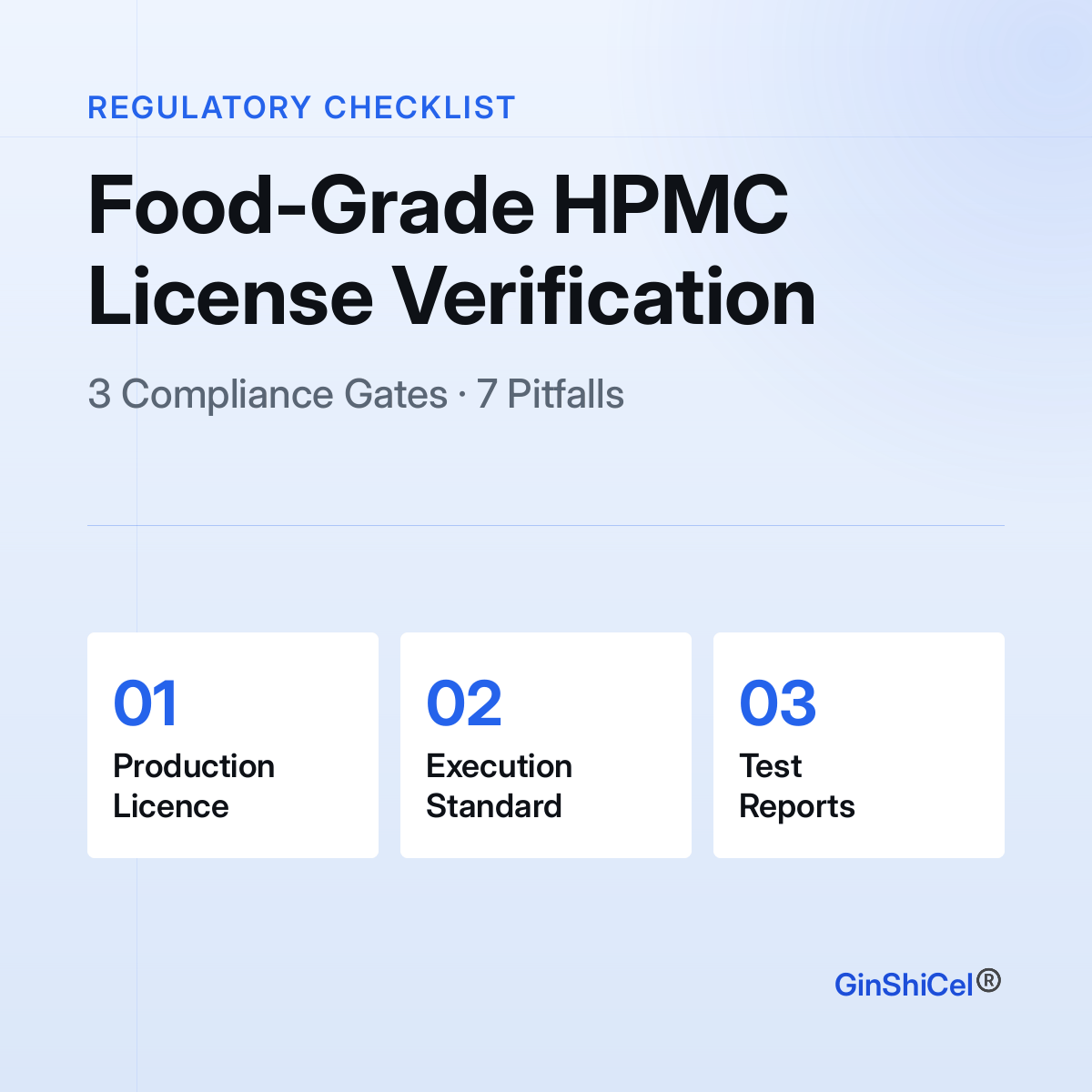
"Food grade" is not a marketing phrase. It points to three verifiable things: the product must be made under a food additive production licence, it must meet GB 1886.109-2015, and its use must fall inside the food categories permitted by GB 2760-2024. If any one of the three is missing, the material should not be sold as food grade.
Audits rarely fail because a supplier has no licence at all. They fail because the licence does not cover the product being bought. The three sections below follow that order.
- Licence number: a 14-character code beginning SC. Haishen: SC20133060206613.
- Category code: 3201 designates food additives. A licence held under another category does not cover food additives.
- Licensed product list: the item most often skipped. Haishen's reads food additive (hydroxypropyl methyl cellulose, HPMC) — the text in parenthesis is the licensed substance.
- Issue and expiry dates: Haishen's current certificate was issued on 19 April 2024 and is valid until 18 April 2029.
- Issuing authority: Yuecheng District Market Supervision Administration, Shaoxing.
Read that carefully: the licensed item is HPMC specifically. When auditing a supplier, compare the licensed product list against the exact grade you intend to buy, rather than stopping at the question of whether a food production licence exists at all.
Food production licences are public record. The issuing authority's platform allows a search by licence number or company name. Once you have the record, compare the licensed product list against the copy you were sent — a copy can be edited, the platform record cannot. One minute of that beats three extra documents.
Methyl cellulose is a separate cellulose ether with its own regulatory basis — E461 in the EU and 21 CFR 172.872 in the United States. Haishen supplies food grade MC grades (MC15-G, MC4000-G, MC15000-G, MC40000-G) for export orders, reviewed case by case against the destination market. The Chinese licence described above covers HPMC, so MC-based food applications should be confirmed with the sales team for the specific market rather than assumed to carry the same status.
Food grade HPMC in China is specified by GB 1886.109-2015. The items buyers check most often: appearance white to off-white fibrous powder or granule; methoxyl 19.0%–30.0%; hydroxypropoxyl 3.0%–12.0%; loss on drying ≤5.0%; residue on ignition ≤1.5%; lead ≤3.0 mg/kg.
Viscosity is the one item with banded tolerances. For a declared viscosity of 100 mPa·s or below, the measured value must fall within 80.0%–120.0% of the declared figure; above 100 mPa·s, within 75.0%–140.0%.
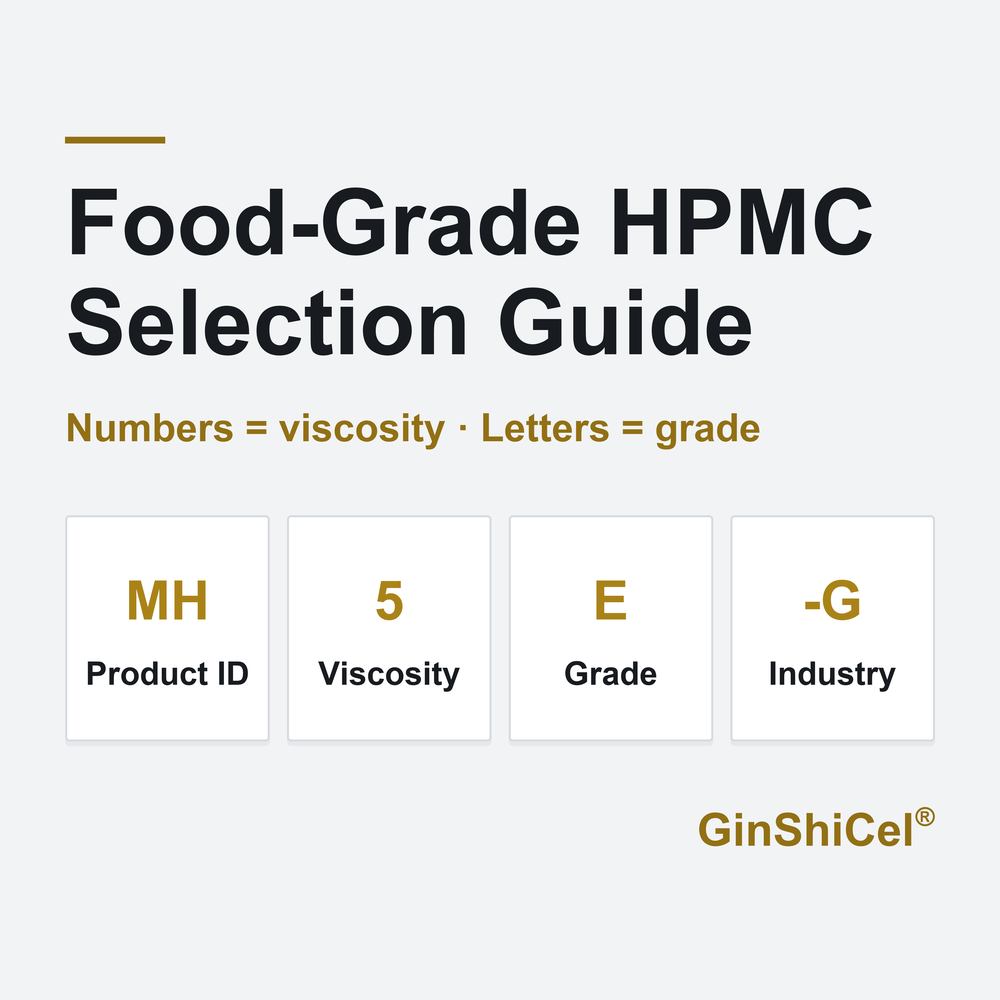
Do not compare numbers alone. Under Table A.1 of GB 1886.109-2015 each declared band has its own spindle, speed and factor, at a test temperature of 20 °C ± 0.1 °C. For example: MH5E-G is declared at 5 mPa·s — spindle 1, 60 r/min, factor 1. MH4000-G is declared at 4,000 mPa·s — spindle 4, 60 r/min, factor 100. Same speed, different spindle, and a hundredfold difference in factor.
Asking for those four conditions tells you more than asking for a pass certificate.
GB 2760-2024 lists HPMC in Table A.2, the additives that may be used in foods "quantum satis", with the functional class thickener. For most food categories there is no maximum level; the addition level is set by what the process actually needs.
Table A.2 comes with an exception list, Table A.3. Categories on that list cannot rely on "quantum satis". For HPMC the relevant ones include wheat flour (06.03.01), fresh wet noodle products (06.03.02.01), dry noodle products (06.03.02.02), coarse grain flour (06.04.01) and raw grain (06.01).
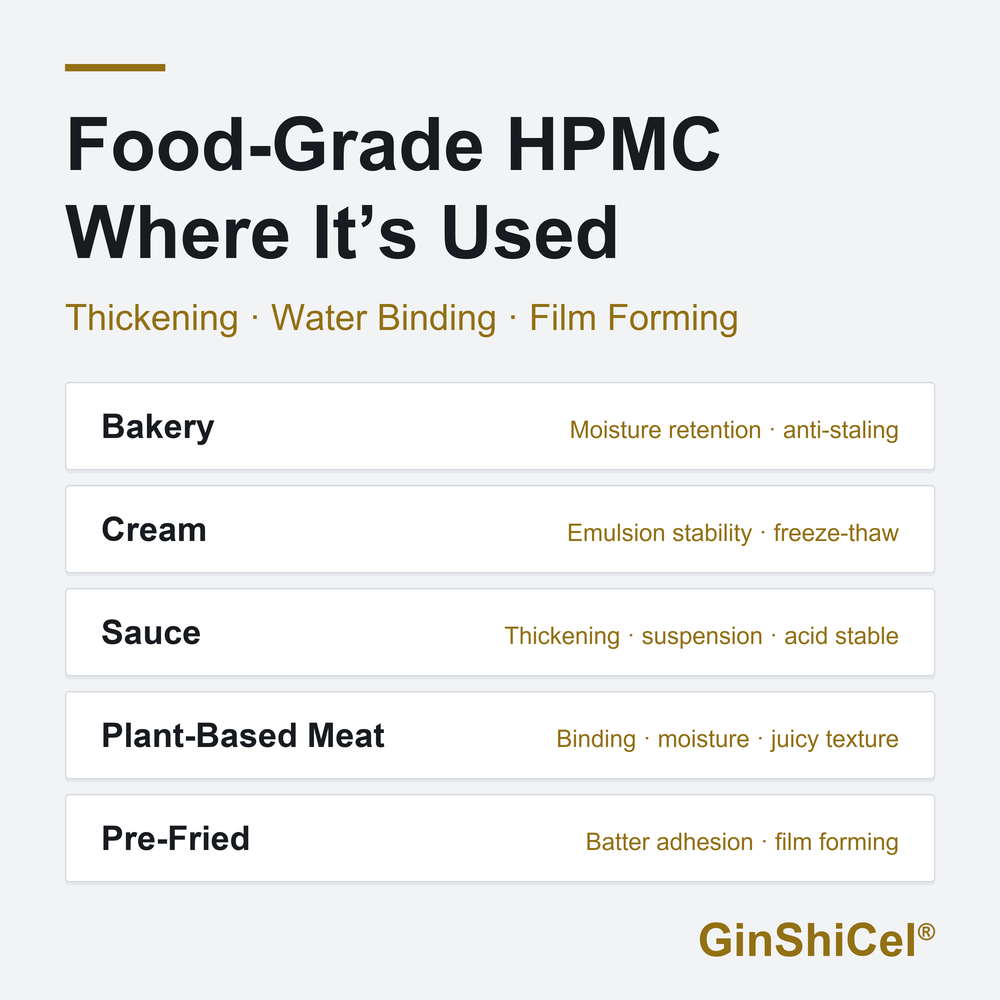
In practice, bread, cake and pastry are inside the permitted scope, while adding HPMC to wheat flour itself is an exception case. The deciding factor is the food category the finished product falls into — not whether flour is an ingredient.
- Licence number and category code — searchable, code 3201.
- Licensed product list — matches the grade you are buying.
- Specification — GB 1886.109-2015, six routine limits aligned item by item.
- Viscosity test conditions — temperature, spindle, speed and factor together.
- Food category — your finished product's category number against Table A.2 and Table A.3.
- Certification coverage — Halal and Kosher certificates cover the grade you buy; management system certificates are current.
- Batch documents — COA supplied per batch; TDS is the current revision.
- Asking only whether a food production licence exists, without reading the category code.
- Reading the licensed product list at the top level and skipping the parenthesis. A licence for HPMC does not cover MC.
- Treating a construction grade TDS as a food grade specification. The limit items and the test conditions are different sets; they are not interchangeable.
- Comparing viscosity numbers without asking for the conditions. Run the same batch on a different spindle or speed and the reading will not match the declared value.
- Ignoring the Table A.3 exceptions. Premix manufacturers hit this most often, because the category the premix falls into decides the answer.
- Reproducing a third-party test report on your own website or in marketing material. Such reports normally state they may not be used for advertising without the laboratory's approval, and that applies to the buyer as well.
- Inferring from "Halal and Kosher certified" that every grade is covered. Certification covers specific products; check the product scope on the certificate.