


Cellulose Ether (HPMC) for Diatomaceous Earth Paint: Formulation, Reference Recipe, Bond Strength and Application Guide
- What Is Diatomaceous Earth Paint, and Why Does It Need Cellulose Ether?
Diatomaceous earth paint — diatom mud in the Chinese market, where it entered around 2003 — has been in use for more than two decades. Every formulation shares one technical starting point: diatomite has no binding power of its own and provides no workability, so a cellulose ether (HPMC) must turn the powder into a paste that can be trowelled and will hold on the wall. In a dry-mix product like this, how the formulation performs is largely decided by the admixtures. Its value proposition sits in three areas — environmental profile, functionality and decoration.
1.1 Environmental profile
Diatomaceous earth paint is a dry-mix finish: it ships as a powder and is mixed with water on site before application. No solvent-based binder is used. What conventional finishes describe as a “chemical glue” is replaced here by mineral, plant, resin and lime-based powder components. As a result, application does not involve the large-scale solvent evaporation associated with solvent-borne coatings.
One qualification matters: whether a material meets any specific environmental limit should be established from third-party test data for the relevant batch, not asserted without test conditions.
1.2 Functionality
Diatomite, the key functional ingredient, is highly adsorptive. It is widely accepted in the industry that diatomaceous earth paint adsorbs volatile substances generated during renovation — formaldehyde, benzene, ammonia and TVOC — and helps reduce indoor odour. Diatomite also absorbs and releases moisture, which gives the finish a degree of humidity-buffering behaviour. Some formulations add photo-catalyst (titanium dioxide) components; the performance of any such component should be supported by test evidence from its supplier.
The scope of these claims should be stated clearly: they describe properties of the finished wall finish itself, and actual performance depends on the formulation, applied thickness, substrate and indoor conditions. In this supply chain, Zhejiang Haishen New Materials is a raw-material supplier — we provide the cellulose ether that delivers water retention, thickening and adhesion. We do not make performance claims on behalf of the finished wall product.
1.3 Decorative character
Once mixed with water, diatomaceous earth paint becomes a highly workable paste. It can be hand-trowelled into a wide range of textures and patterns: from the smooth finish of an emulsion paint, to wallpaper-style floral effects, to the coarse texture of sandstone or rendered mortar.
- The Four Building Blocks of a Diatomaceous Earth Paint Formulation
Diatomaceous earth paint is a dry-mix mortar product. A complete formulation normally consists of four parts:
- Binder system — slaked lime (calcium hydroxide), water, lime putty and similar materials
- Diatomite — the main functional ingredient
- Fillers — ground calcium carbonate, talc, sand and similar materials
- Admixtures — MC (cellulose ether), redispersible polymer powder, superplasticiser, thixotropic agent, wood fibre, pigment and similar materials
All four are required. Diatomite delivers the function; the binder and fillers form the structure; the admixtures determine whether the product can be mixed, trowelled and applied without cracking.
2.1 Diatomite: the functional core
Diatomite — the main functional raw material in diatomaceous earth paint — is a biogenic sedimentary mineral. As the most important component of the product, it is characterised by a high specific surface area and high porosity. This unusual mineral structure is what gives diatomaceous earth paint its strong breathability and adsorption capacity, and it is the reason the finish can adsorb substances such as formaldehyde. A finish built on diatomite also helps dehumidify, deodorise and improve indoor air, on top of not releasing harmful chemicals.
One critical point must be made explicit: diatomite itself has no binding power and provides no workability — used alone, it cannot be applied to a wall. That is precisely why a cellulose ether is required.
- Admixture Selection: Nine Additives and What They Do
| Admixture | Suitable processes | Function |
| 1. Cellulose ether (HPMC) | General | Workability, water retention, thickening |
| 2. Redispersible polymer powder (RDP) | General | Improves adhesion, adds flexibility |
| 3. Starch ether (HPS) | Texturing and spray processes requiring plasticity | Improves sag resistance |
| 4. Thixotropic agent | Texturing and spray processes requiring plasticity | Improves sag resistance and trowelling smoothness |
| 5. Superplasticiser | Printing and similar processes | Improves flow, reduces water demand |
| 6. Pigment dispersant | General | Improves colour development |
| 7. Gypsum retarder | Used in gypsum-based diatomaceous earth paint | Extends open time and strength |
| 8. Wood fibre | General | Reduces cracking, increases strength |
| 9. Defoamer | General | Reduces pinholes and colour streaks |
“General” means the admixture is used in most diatomaceous earth paint formulations. The exact selection and dosage for any given formulation should be confirmed by testing.
- A Reference Formulation
| Component | Parts by weight |
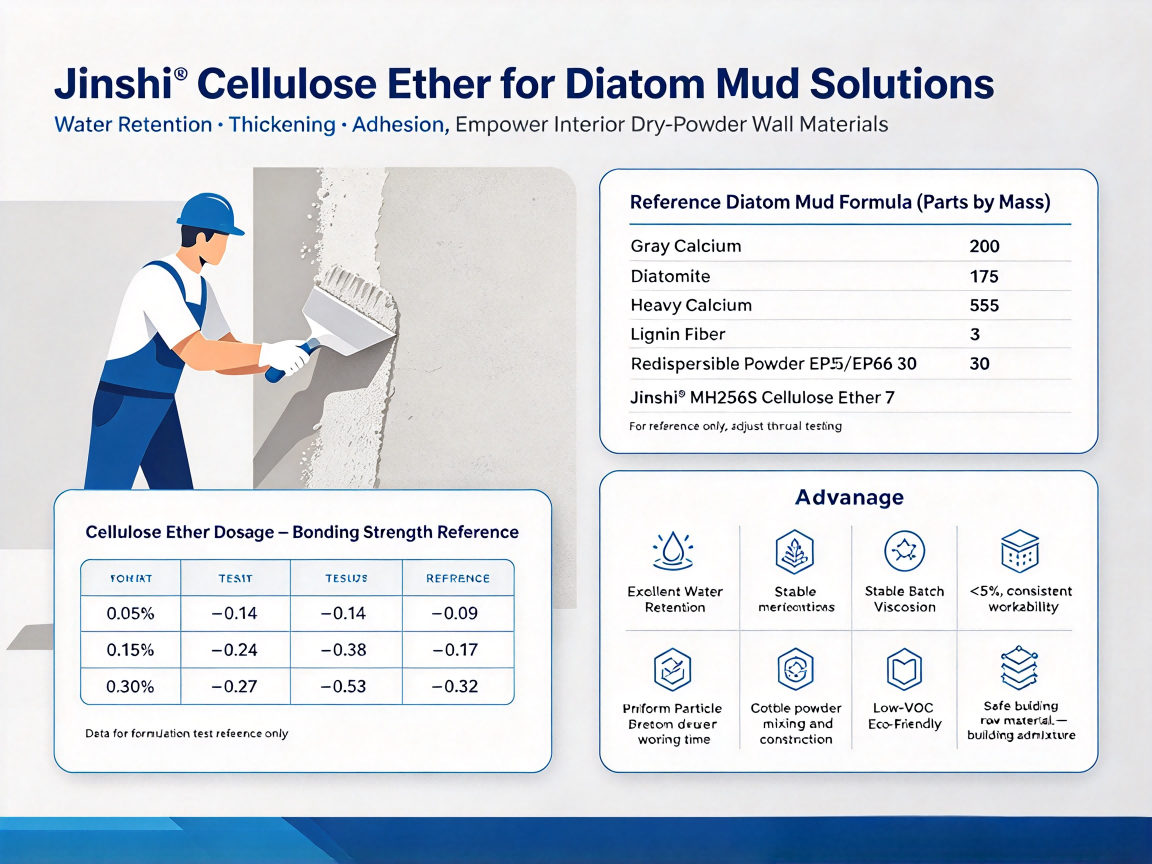
| Slaked lime (calcium hydroxide) | 200 |
| Diatomite | 175 |
| Ground calcium carbonate | 555 |
| Wood fibre | 3 |
| Redispersible polymer powder (EP55 / EP66) | 30 |
| GinShiCel® cellulose ether (MH256S) | 7 |
This table is a reference ratio, shown to illustrate the approximate proportion between components. A production formulation should be confirmed by testing, taking into account raw-material batch variation, application method and target performance.
- What Cellulose Ether Does: Water Retention, Thickening, Bond Strength
Diatomaceous earth paint has a high water demand — the water requirement is typically above 65% — and it also places high demands on workability. The role of cellulose ether comes down to three things:
- Water retention — holds water in the paste, extends open time, and prevents the porous diatomite and substrate from drawing moisture away too quickly.
- Thickening — builds body in the system so the paste has the flow and smoothness needed for trowelling.
- Bond strength — binds diatomite particles together with the inorganic binder and fillers into a single system.
5.1 Cellulose ether dosage vs bond strength
| Cellulose ether dosage | Bond strength (untreated) | Bond strength (water-immersed) |
| 0.05% | 0.14 | 0.09 |
| 0.15% | 0.24 | 0.17 |
| 0.30% | 0.38 | 0.27 |
| 0.70% | 0.53 | 0.32 |
Data taken from the original application study. Actual values vary with mix design, raw-material batch and curing conditions; figures are indicative only.
Two trends are visible. First, bond strength rises as dosage increases. Second, bond strength after water immersion is clearly lower than in the untreated state — which indicates that the water resistance of the diatomaceous earth paint system is inherently limited, and that the gap widens when dosage is too low.
This leads to the dosage recommendation: because diatomaceous earth paint has a high water demand (typically above 65%) and demanding workability requirements, the cellulose ether dosage in the formulation should be above 0.5%, so that the system has adequate flow, smoothness and consistency. It should not fall below 0.3%–0.4%. The final dosage should be established through mix-design testing.
- Four Advantages of GinShiCel® Cellulose Ether in Diatomaceous Earth Paint
- Excellent water retention — extends the working time available for applying diatomaceous earth paint.
- Viscosity consistency — strict in-process monitoring at every stage of production keeps batch-to-batch viscosity variation below 5% (subject to factory inspection data).
- Uniform particle size — a multi-stage sieving process gives GinShiCel® cellulose ether a comparatively narrow and uniform particle-size distribution, which brings consistency to mixing and application.
- Environmental profile — GinShiCel® cellulose ether is produced from natural cellulose (cotton linter pulp) and washed repeatedly after etherification. It contains no volatile organic compounds (VOC) and is a comparatively safe admixture for building materials; relevant data can be provided batch by batch.
- GinShiCel® Products for Diatomaceous Earth Paint
- GinShiCel® cellulose ether MH256S
- Redispersible polymer powder EP55 / EP66
- Wood fibre
- And more
Beyond the products listed above, we can supply other related products according to customer requirements.
- Eight Rules for Applying Diatomaceous Earth Paint
- The wall must be flat and clean, with no cracking and no water penetration.
- Mix evenly; a power mixer may be used.
- Apply in two passes. The first pass is about 1 mm thick; once it is no longer tacky, apply the second pass at about 1.5 mm. Total thickness across both passes must not exceed 3 mm.
- Let it dry naturally. Do not open windows for ventilation or allow direct sunlight in order to rush the schedule. If both the air and the floor are very dry, sprinkle more water on the floor or mist the air to raise humidity.
- Texture under pressure. Work carefully and lightly to avoid powdering. Once the material has fully dried, use a brush or damp cloth to remove loose dust from the edges and surface completely.
- Burnish. Use a finishing trowel to compact and burnish along the direction of the pattern, controlling pressure carefully.
- Application temperature: above 5 °C, with relative humidity below 85%. At around 23 °C, drying normally takes 24 hours; at lower temperatures, extend the drying time to achieve the best result.
- Final curing. Diatomaceous earth paint is normally applied in a single continuous operation; after completion, cure for 24 hours in summer and 48 hours in winter. During this period, avoid impact, pressure, rubbing or poking at the surface. If damage occurs, contact the applicator promptly for repair, or patch with matching material, so the finished appearance is not affected.
- Technical Support and Service
Zhejiang Haishen New Materials is a specialist developer and manufacturer of non-ionic cellulose ethers in East China, and is one of the drafting participants in the cellulose ether industry standard.
Founded in 1990, we have invested continuously in R&D for more than three decades. Our technical service team handles the full range of customer questions, and we can provide:
- Products with consistent quality
- Individually tailored products with a high cost-performance ratio, developed around each customer’s core requirements
- Starting formulations and dedicated formulations for each product range
- Fast, efficient and comprehensive technical service, covering the issues that arise in use
On testing: Haishen can arrange third-party testing at the customer’s request, and inspection reports can be issued batch by batch.
- Frequently Asked Questions
Q: Why is cellulose ether essential in diatomaceous earth paint?
A: Because diatomite has no binding power of its own and provides no workability — on its own it cannot be applied to a wall. Cellulose ether supplies water retention, thickening and adhesion, so the paste can be trowelled, applied and allowed to set.
Q: What dosage of cellulose ether is used in diatomaceous earth paint?
A: Water demand in diatomaceous earth paint is typically above 65%, so the cellulose ether dosage should be above 0.5% and should not fall below 0.3%–0.4%. The final dosage should be established by mix-design testing.
Q: Should I choose HPMC or another cellulose ether?
A: Dry-mix mortar systems, including diatomaceous earth paint, normally use HPMC. It disperses in both cold and hot water, has strong water retention, and is compatible with inorganic binders such as slaked lime and cement. The specific grade is selected according to target viscosity, water-retention requirement and application method.
Q: Does a higher cellulose ether dosage always mean higher bond strength?
A: Within the tested range, bond strength does rise with dosage (0.14 untreated at 0.05%, rising to 0.53 at 0.70%). But higher dosage also raises consistency, makes the paste harder to work and increases cost — so the target is to meet workability and adhesion requirements, not to maximise dosage.
Q: Why does diatomaceous earth paint crack?
A: It is a porous, high-water-demand system with noticeable shrinkage. Common causes include insufficient cellulose ether causing poor water retention, applying a single pass too thick (total thickness across both passes should not exceed 3 mm), and drying too fast through draughts or direct sunlight. Wood fibre is also used in the formulation to reduce cracking.
Q: What should I watch during application?
A: The wall must be flat, clean, uncracked and free of water penetration; apply in two passes with total thickness under 3 mm; allow natural drying without draughts or direct sunlight; clean loose dust only after full drying; apply above 5 °C and below 85% relative humidity; and cure for 24 hours in summer and 48 hours in winter.
Q: What support can Zhejiang Haishen provide?
A: Haishen supplies products with consistent quality, individually tailored products, starting and dedicated formulations, and technical support on mix design and application issues. Third-party testing can be arranged at the customer’s request, with inspection reports issued batch by batch.
Zhejiang Haishen New Materials Co., Ltd. | GinShiCel® cellulose ether | www.haishenchem.com