


Choosing a Food Grade HPMC Supplier: Three Grades, Five Applications and Three Compliance Checks
- What food grade HPMC is
Hydroxypropyl methyl cellulose (HPMC, also called hypromellose) is a non-ionic cellulose ether made by etherifying natural cellulose with methoxyl and hydroxypropoxyl groups. It is a white to off-white fibrous powder or granule, odourless and tasteless, that swells in water to form a colloidal solution. Its food additive number is E464 (INS 464); CAS 9004-65-3.
"Food grade" is not a marketing phrase. It points to three verifiable things: the product must be made under a food additive production licence, it must meet the applicable specification, and its use must fall inside the food categories permitted by the relevant additive standard. If any one of the three is missing, the material should not be sold as food grade.
Under China's GB 2760-2024, HPMC is registered with a single functional class — thickener. Water retention, film formation, emulsion stabilisation and thermal gelation are effects it delivers in a formulation; they do not change its regulatory classification.
- Three compliance checks before you select a grade
2.1 Check 1 — production licence
Zhejiang Haishen New Materials Co., Ltd. holds food production licence SC20133060206613, category 3201 (food additives), with the licensed product listed as food additive (hydroxypropyl methyl cellulose, HPMC). It was issued on 19 April 2024 and is valid until 18 April 2029 by the Yuecheng District Market Supervision Administration, Shaoxing.
Read that carefully: the licensed item is HPMC specifically. When auditing a supplier, compare the licensed product list against the exact grade you intend to buy, rather than stopping at the question of whether a food production licence exists at all.
2.2 Check 2 — product specification
Food grade HPMC in China is specified by GB 1886.109-2015. The table below lists the items buyers and QC teams check most often; these are also the routine control points for Haishen food grades.
|
Parameter |
Requirement |
What it governs |
|
Appearance |
White to off-white fibrous powder or granule |
Colour and form; reflects raw material and finishing |
|
Methoxyl (–OCH₃) |
19.0%–30.0% |
Dissolution temperature and thermal gel behaviour |
|
Hydroxypropoxyl (–OCH₂CHOHCH₃) |
3.0%–12.0% |
Surface activity, gel strength, salt tolerance |
|
Loss on drying |
≤5.0% |
Moisture; higher values promote caking |
|
Residue on ignition |
≤1.5% |
Inorganic residue; reflects product purity |
|
Lead (Pb) |
≤3.0 mg/kg |
Heavy metal control |
|
Viscosity |
80.0%–120.0% of declared value (declared ≤100 mPa·s) |
Tolerance depends on the declared band |
|
|
75.0%–140.0% of declared value (declared >100 mPa·s) |
|
Source: GB 1886.109-2015. Routine control values for Haishen food grades are given in the individual TDS and COA.
2.3 Check 3 — permitted food categories
GB 2760-2024 lists HPMC in Table A.2, the additives that may be used in foods "quantum satis", with the functional class thickener. For most food categories there is no maximum level; the addition level is set by what the process actually needs.
Table A.2 comes with an exception list, Table A.3. Categories on that list cannot rely on "quantum satis". For HPMC the relevant ones include wheat flour (06.03.01), fresh wet noodle products (06.03.02.01), dry noodle products (06.03.02.02), coarse grain flour (06.04.01) and raw grain (06.01). In practice: bread, cake and pastry — bakery products — are inside the permitted scope, while adding HPMC to wheat flour itself is an exception case.
This is the point formulators most often miss. Two customers can both be "in baking" and reach different compliance conclusions, because the deciding factor is the food category the finished product falls into — not whether flour is an ingredient.
- How to read a grade code: MH5E-G
Haishen food and pharma grades use one naming system for both domestic and export orders, built from four fields. Take MH5E-G:
|
Field |
Value |
Meaning |
|
Product code |
MH |
Hydroxypropyl methyl cellulose (HPMC); methyl cellulose is MC |
|
Declared viscosity |
5 |
5 mPa·s nominal, measured range 4–6 mPa·s |
|
Grade letter |
E |
Substitution grade: E / F / K. A code with no letter (e.g. MH4000-G) is grade K |
|
Application code |
-G |
Special grade — food and pharmaceutical |
The grade letter is the field most often skipped, and it is the one that changes process outcomes. Same viscosity, different grade letter means different substitution, and therefore a different gelation temperature and different surface activity.
|
Grade |
Methoxyl |
Hydroxypropoxyl |
Effect in application |
|
E |
28.0%–30.0% |
7.0%–12.0% |
Relatively lower gelation temperature, stronger surface activity |
|
F |
27.0%–30.0% |
4.0%–7.5% |
Thermal behaviour between E and K |
|
K (often omitted) |
19.0%–24.0% |
4.0%–12.0% |
Relatively higher gelation temperature, strong water retention |
Grade ranges are routine control windows. The TDS for food grade HPMC declares methoxyl 19.0%–30.0% and hydroxypropoxyl 3.0%–12.0% per GB 1886.109-2015; batch values are given in the COA.
- Three food grades
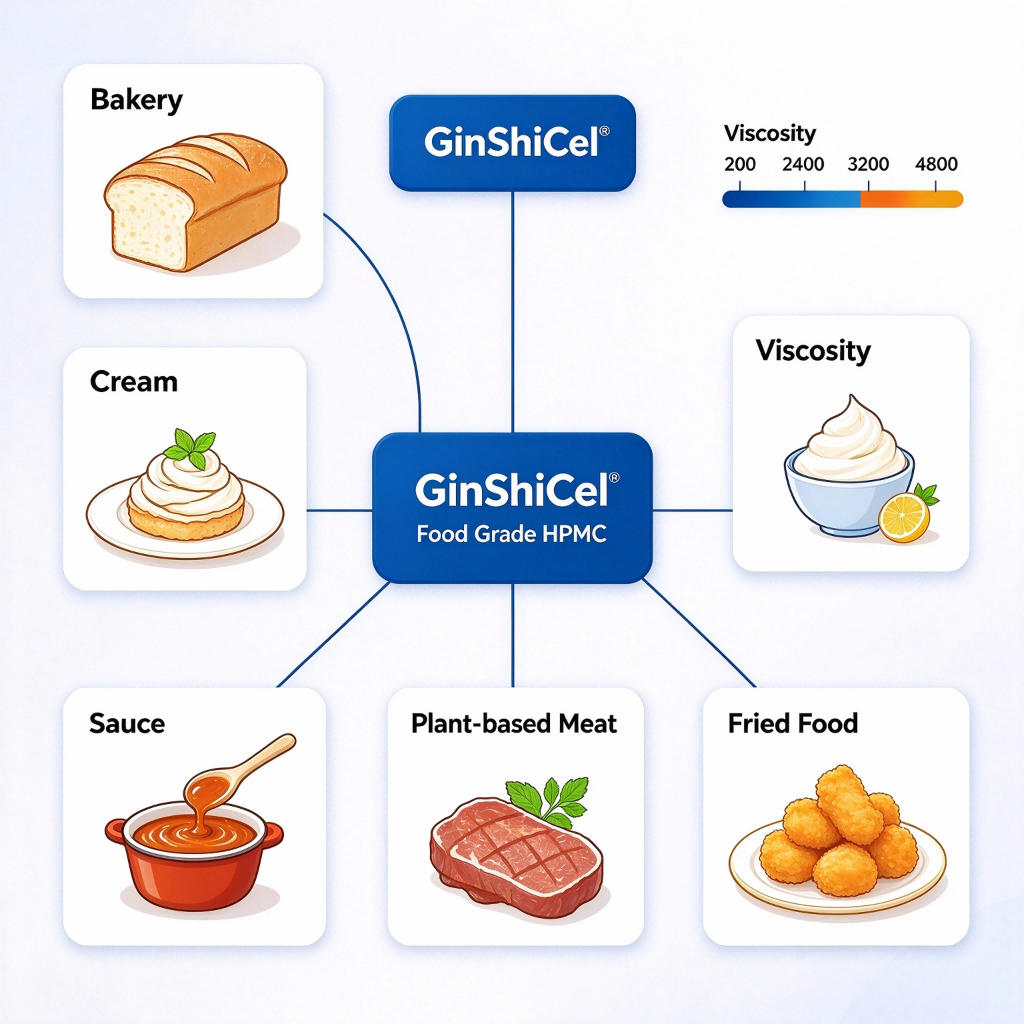
Haishen currently offers three standard food grade HPMC products, covering the low and medium viscosity bands.
|
Grade |
Declared viscosity |
Measured range |
Letter |
Main applications |
|
MH5E-G |
5 mPa·s |
4–6 mPa·s |
E |
Dairy cream, sauces and seasonings |
|
MH4000-G |
4,000 mPa·s |
3,200–4,800 mPa·s |
K |
Bakery (bread, cake, gluten-free) |
|
MH4000E-G |
4,000 mPa·s |
3,200–4,800 mPa·s |
E |
Plant-based meat, fried coatings |
Shared specification across the three: white to off-white fibrous powder or granule; methoxyl 19.0%–30.0%; hydroxypropoxyl 3.0%–12.0%; loss on drying ≤5.0%; residue on ignition ≤1.5%; lead ≤3 mg/kg. Packed at 20 kg or 25 kg in double LDPE inner bags with woven bag or fibre drum outer; shelf life two years under the specified storage conditions.
4.1 MH4000-G and MH4000E-G: same viscosity, different grade
Both are declared at 4,000 mPa·s with a 3,200–4,800 mPa·s measured range. The difference is one field: MH4000-G is grade K, MH4000E-G is grade E. Selecting on viscosity alone is how mistakes happen — a buyer wanting a particular thermal behaviour and a supplier quoting on viscosity can both be looking at matching numbers while the process outcome differs.
In use, the difference shows up in thermal processing. Plant-based meat needs a rigid gel network to set the protein particles during cooking and frying, and fried coatings need a film that forms fast enough to block oil uptake — both favour grade E, with its lower gelation temperature and faster film formation. Bread and cake depend more on gas retention and water binding; grade K, with its higher gelation temperature, leaves the dough longer to hold gas during proofing and the early part of baking.
4.2 Checking viscosity correctly
Viscosity is not an absolute number; it depends on the measurement conditions. Food grade HPMC is measured with a rotational viscometer as set out in GB 1886.109-2015, at 20 °C ± 0.1 °C. Each declared viscosity band specifies its own spindle, speed and factor.
|
Declared viscosity (mPa·s) |
Spindle |
Speed (r/min) |
Factor |
|
1–15 |
1 |
60 |
1 |
|
15–300 |
2 |
60 |
5 |
|
300–1,400 |
3 |
60 |
20 |
|
1,400–3,500 |
3 |
12 |
100 |
|
3,500–9,500 |
4 |
60 |
100 |
|
9,500–99,500 |
4 |
6 |
1,000 |
|
>99,500 |
4 |
3 |
2,000 |
Source: GB 1886.109-2015, Table A.1 (rotational viscometer test conditions); test temperature 20 °C ± 0.1 °C.
A concrete comparison: MH5E-G is declared at 5 mPa·s, which falls in the 15–75 band — spindle 1, 60 r/min, factor 1. MH4000-G is declared at 4,000 mPa·s, in the 3,500–9,500 band — spindle 4, 60 r/min, factor 100. The speed is the same, but the spindle differs and the factor differs by a hundredfold.
Run the same batch on a different spindle or at a different speed and the reading will not match the declared value — that is a difference in conditions, not a non-conforming batch. Match temperature, spindle, speed and factor together before comparing numbers.
- Matching five applications to three grades
The mapping below is deliberately not one grade per application. MH5E-G serves both dairy cream and sauces; MH4000E-G serves both plant-based meat and fried coatings. The pairing follows the underlying need: the low band solves emulsion stability, the medium band solves water binding and thermal setting.
5.1 Bakery — MH4000-G
In bread, cake, gluten-free baked goods and premix systems, HPMC swells in water to form a colloidal network that improves gas retention and water binding in the dough and slows starch retrogradation. Gluten-free formulations depend on this more heavily, because there is no gluten network to do the job.
In representative applications, batter gas retention, gluten-free bread volume and dough water retention all improve, with corresponding changes in staling rate and ambient shelf life; emulsion stabilisation contributes to a more even crumb and lower collapse rate in cakes. See the data note at the end for the basis of these figures.
5.2 Dairy cream — MH5E-G
Non-dairy cream, whipping cream, fermented milk and milk-based drinks all hinge on emulsion stability and foam retention. Low viscosity HPMC strengthens the oil-water interface, suppresses fat creaming, improves whipping behaviour and foam shape retention, and reduces separation during storage and transport.
5.3 Sauces and seasonings — MH5E-G
Compound seasoning sauces, salad dressings, base sauces and liquid seasonings need thickening, emulsification, suspension of solid particles and suppression of oil-water separation. The low band thickens without a heavy mouthfeel, keeps pouring resistance moderate and reduces hold-up in pumps and on walls, while keeping spice particles suspended.
5.4 Plant-based meat — MH4000E-G
Plant-based meat built on vegetable protein needs water binding, thermal gel setting and stronger adhesion between protein particles, so that the product does not shrink and lose water during cooking and can mimic the texture of meat. The medium viscosity E grade develops higher gel network strength and protein adhesion on heating, which is its value in these formulations.
5.5 Prepared fried foods — MH4000E-G
Battered and breaded products, vegetable steaks and prepared fried snacks need a barrier film during frying: lower oil uptake, less leakage and crumb shedding, and structural integrity. Grade E forms a film faster at high temperature and produces a denser gel barrier, reducing cracking of the crust and improving moisture retention inside the product.
- A five-step selection sequence
Step 1 — Identify the system type. Is it a liquid emulsion (cream, sauce), a solid or thermally processed system (plant-based meat, fried coating), or a fermented or baked system (bread, cake)? This sets the viscosity band.
Step 2 — Set the viscosity band. For emulsification, foam stability and thickening without a heavy mouthfeel, use the low band (4–6 mPa·s). For gas retention, water binding and thermal gel setting, use the medium band (3,200–4,800 mPa·s). Haishen does not hold a standard food grade in the roughly 100–3,000 mPa·s range; that band is available on a custom basis.
Step 3 — Choose the grade letter. Where fast thermal gelation and an oil-blocking film matter, take grade E. Where gas retention and water binding dominate and gelation temperature is not critical, take grade K.
Step 4 — Verify the viscosity test conditions. Food grade HPMC is measured to GB 1886.109-2015 Table A.1, where spindle and speed change with the declared viscosity band. Confirm that the supplier's conditions match your own method, then compare numbers.
Step 5 — Confirm permitted use and dosage. Identify the food category number of your finished product, check whether it appears on the Table A.3 exception list, and for export products check the destination market separately.
- Regulatory status and documents
Supplier audits usually ask for a document set. Haishen can currently provide:
|
Category |
Document |
|
Production licence |
Food production licence SC20133060206613 (product: food additive HPMC) |
|
Management systems |
ISO 9001 quality, ISO 14001 environmental, ISO 45001 occupational health and safety |
|
Religious compliance |
Halal certificate (HPMC); Kosher certificate (HPMC) |
|
US market |
FDA Food Facility Registration No. 10890981470 |
|
Product documents |
TDS per grade, COA per batch; compliance document pack on request |
One clarification on the FDA item, because it is frequently mis-stated in supplier documents. The Food Facility Registration is a registration of the manufacturing facility with the US Food and Drug Administration. It is not an "FDA certification" of the product, and it does not represent FDA approval of the substance. For HPMC, the basis for use as a food additive in the United States is 21 CFR 172.874; for methyl cellulose it is 21 CFR 172.872. Facility registration and substance authorisation are two separate things, and a competent QA reviewer will separate them.
In the EU, HPMC is authorised as E464 and methyl cellulose as E461 under Regulation (EC) No 1333/2008, with specifications laid down in Regulation (EU) No 231/2012. JECFA has established an ADI "not specified" for the modified celluloses E461–E466. Buyers should confirm the applicable regulation for their own market before use.
7.1 Methyl cellulose (E461)
Methyl cellulose is a separate cellulose ether with its own regulatory basis — E461 in the EU and 21 CFR 172.872 in the United States. Haishen supplies food grade MC grades (MC15-G, MC4000-G, MC15000-G, MC40000-G) for export orders, reviewed case by case against the destination market's requirements. Note that Haishen's Chinese food additive production licence covers HPMC; MC-based food applications are handled as export business and should be confirmed with the sales team for the specific market rather than assumed to carry the same status as HPMC.
- Frequently asked questions
What is the difference between food grade and construction grade HPMC?
The base chemistry is the same cellulose ether; the difference is in specification control, production licensing and the regulations that apply. Food grade must meet the appearance, substitution, loss on drying, residue on ignition and lead limits of GB 1886.109-2015 and must be made on a line covered by a food additive production licence. Construction grade is not subject to those requirements and must not enter the food chain. The two are not interchangeable.
Which food categories may use HPMC under GB 2760?
GB 2760-2024 lists HPMC in Table A.2 as a thickener usable quantum satis in foods generally, with the Table A.3 exclusions. Dairy products, frozen drinks, bakery products, meat products and seasonings are within scope.
Why can HPMC not be added to wheat flour?
Because wheat flour (06.03.01) appears on the Table A.3 exception list, and the quantum satis provision of Table A.2 does not apply to categories on that list. Note the distinction: bread (07.01) and pastry (07.02) are bakery products and are permitted; wheat flour, fresh wet noodles and dry noodles are exceptions. Premix manufacturers should confirm the food category their finished product falls into first.
MH4000-G or MH4000E-G — which one?
It depends on whether the process relies on fast thermal gelation. For rapid setting or an oil-blocking film at high temperature (plant-based meat, fried coatings), take MH4000E-G, grade E. For gas retention and water binding (bread, cake), take MH4000-G, grade K. The viscosity is identical, so they cannot be substituted on viscosity alone.
Your declared viscosity does not match our measurement — is the batch out of specification?
Check the measurement conditions first. Food grade HPMC viscosity is measured to GB 1886.109-2015 Table A.1, where temperature, spindle, speed and factor change with the declared viscosity band. Align all four, then compare. If a question remains, share your method and our technical team will review it with you.
Do you hold Halal and Kosher certificates?
Yes. GinShiCel® HPMC holds both Halal and Kosher certification, and copies can be provided for audit files.
Can other cellulose ethers be used in food?
Haishen's current Chinese food production licence covers hydroxypropyl methyl cellulose (HPMC). Other cellulose ethers fall under different licensing and regulatory requirements, and some have different compliance routes in different countries. Confirm the grade, the destination market and the applicable regulation with the sales team rather than applying HPMC's conclusions to them.
- About Zhejiang Haishen New Materials Co., Ltd.
Founded in 1990 and based in Lihai, Yuecheng District, Shaoxing, Zhejiang, Haishen has specialised in non-ionic cellulose ethers for more than three decades and is one of the drafting units for the Chinese cellulose ether industry standard. The product range covers HPMC, HEMC, MC, HEC, HPC, redispersible polymer powder (RDP), hydroxypropyl starch ether (HPS) and polyvinyl alcohol (PVA), serving construction, coatings, personal care, oil drilling, food and pharmaceutical applications, with exports to more than 80 countries and regions.
The company holds food additive production licence SC20133060206613 for food additive hydroxypropyl methyl cellulose (HPMC). The current certificate was issued on 19 April 2024 and is valid until 18 April 2029. The food grade line is now in active supply. The food grade range is supported by ISO 9001, ISO 14001 and ISO 45001 management systems, Halal and Kosher certification for HPMC, and FDA Food Facility Registration No. 10890981470.
Zhejiang Haishen New Materials Co., Ltd. | GinShiCel® cellulose ethers | www.haishenchem.com
Data note: improvement percentages quoted in this article (gas retention, water retention, oil uptake and similar) come from Haishen internal application testing. Test formulations and conditions are available from the technical team on request. Actual results depend on raw materials, formulation, dosage and process conditions.